Rodent Control Tips for Warehouses
My cousin Arjun manages a dry goods warehouse on the outskirts of Jaipur. Atta, dal, rice, packaged snacks — the kind of operation that runs seven days a week with loading and unloading happening at odd hours. Last year he called me after a stock audit revealed something nobody had caught during routine operations: a section of stored rice sacks in the back corner had sustained significant rodent damage. Several bags chewed through. Significant contamination. A loss he had to write off entirely.
The warehouse had pest control done. Every few months, a company would come, spray around the perimeter, set some traps, leave. On paper, covered. In practice — not really. The company was treating a warehouse the way they'd treat a flat. Same general approach, same placement of traps along walls, same surface spray. A flat and a warehouse are not the same problem.
A 5,000 square foot warehouse storing edible goods is a different challenge from a 1,200 square foot residential flat. The scale is different. The entry points are different. The stakes are different — because contaminated food stock is a health risk and a financial loss, not just a nuisance. And the treatment approach needs to reflect all of that.
Here is what actually works for rodent control in warehouses — specifically, practically, for Indian commercial storage conditions.
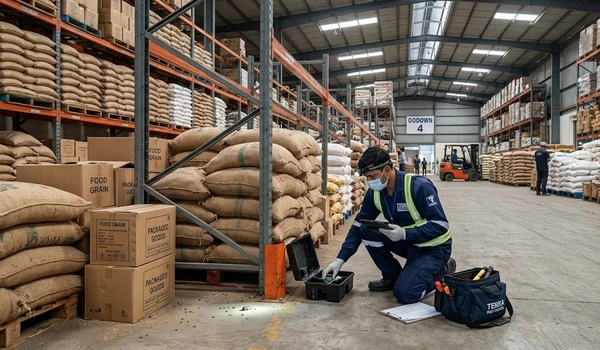
Why Warehouses Are Particularly Vulnerable
Understanding why warehouses attract and sustain rodent populations better than almost any other structure helps in addressing the problem systematically rather than reactively.
Food storage is the obvious factor. A warehouse storing grain, pulses, packaged food, or any organic product is advertising itself through smell to every rat within range. Rats can detect food sources from significant distances — grain smell travels, particularly in warm weather. A warehouse with edible stock in a semi-urban or industrial area is surrounded by a rat population that is constantly probing it for access.
The scale creates blind spots. A residential home can be checked corner by corner in thirty minutes. A warehouse has racking systems, stacked pallets, false ceiling sections, loading docks, mezzanine floors, and structural voids that create dozens of enclosed, dark, protected spaces. A rat colony can establish in the back corner of a pallet stack that hasn't been fully cleared in three months without anyone noticing until the audit reveals damage.
The operational pattern creates regular entry opportunities. Loading and unloading means the large dock doors are open repeatedly during the day — sometimes for extended periods. Every time a door is open, it's an entry opportunity. Vehicles bringing stock also sometimes bring stowaways — rats that travel in cargo or on vehicles from other locations.
The building construction typically has more gaps than residential construction. Industrial buildings prioritise function over airtight sealing. Gaps around loading dock edges, under roller shutter doors, around utility penetrations, where roofing material meets walls — all of these are more common and less carefully addressed in warehouse construction than in residential buildings.
Inspection First — Map the Problem Before Treating It
The single biggest mistake in warehouse rodent control — and the reason Arjun's previous treatment wasn't working — is treating without adequately mapping where the problem actually exists.
A proper warehouse rodent inspection has specific components that residential inspection doesn't need to include.
Perimeter inspection — the full external perimeter of the building, looking for burrow holes in soil near the foundation, gaps under roller shutter doors, cracks in the external wall, gaps around any utility penetration, and the condition of any vegetation or debris against the building's exterior. Rats establish burrows within metres of the food source when they can. External burrows near the building perimeter are the first indicator of the population's scale.
Loading dock area specifically — the area around dock doors, the dock levellers, the gap between the dock structure and the incoming vehicle, and any pit or void associated with the dock infrastructure. Loading docks are the primary entry point in most Indian warehouses because they have the largest gaps, the most frequent opening and closing, and the most vehicle traffic introducing new rats from other locations.
Interior racking and pallet positions — specifically any area where pallets or racking has been in place for more than six to eight weeks without being fully cleared. Rats establish under and behind static pallets quickly. Any droppings found in an inspection should be mapped to specific racking positions — this tells you where the colony is operating, not just that one exists.
Roof and ceiling void — through any accessible hatch or removable section. Rats travel through roof voids extensively in warehouses and can be active overhead while the floor shows minimal evidence. A warehouse with roof activity and minimal floor droppings is often misdiagnosed as having low infestation when it actually has an established roof population.
The inspection output should be a specific map: where droppings were found and approximately how fresh, where gnaw marks were identified on stock or structure, where the suspected entry points are, and what the racking layout suggests about where rats are operating versus where they're not being found. Treatment is planned against this map, not applied uniformly.
Entry Point Sealing — The Foundation That Everything Else Depends On
Baiting removes the current rat population. Entry point sealing prevents the next population from establishing. In a warehouse in or near a populated urban area — which describes most Indian commercial warehouses — there is always a rat population outside the building. The only question is whether they can get in.
The entry points that matter most in a warehouse context:
Under roller shutter doors. The gap between the bottom of a roller shutter door and the floor when the door is closed is often several centimetres — particularly if the door is older or the floor has settled unevenly. This gap, running the full width of a large door, is a straightforward rat highway. A properly fitted rubber bottom seal on the shutter door that compresses to close the gap when the door is down is the solution. This seal needs regular inspection — it degrades over time and the moment it develops a gap, the entry point reopens.
Around service penetrations. Electrical conduit entries, plumbing penetrations, HVAC duct entries, cable entries — any point where something passes through the wall or floor has a gap. In industrial construction these gaps are frequently left unsealed. Steel wool packed into each gap and then sealed with a hard material — expanding foam is not appropriate because rats chew through it; use cement mortar or a hard sealant over the steel wool.
Where roofing meets walls. Purlins, fascia boards, and the junction between the roof sheet and the top of the wall often have gaps that allow entry at roof level. Once a rat is in the roof void, it can enter the main warehouse space through any gap in the ceiling or through roof-mounted equipment penetrations. Inspect the perimeter of the roof-wall junction and seal any gaps with appropriate industrial mesh and sealant.
Dock doors when open. This can't be fully sealed during operations — the door has to be open for loading. But dock doors that are open when not in active use, or kept open for extended periods unnecessarily, should be managed. A dock door that's open for thirty minutes while a vehicle is unloaded is a different risk from a dock door that's left open between vehicles for two hours.
Bait Station Placement — What Works in a Warehouse
Bait stations in a warehouse are not the same as traps in a residential kitchen. The scale, the rat population size, and the operational environment require a specific approach.
Perimeter placement at defined intervals — typically every 10 to 15 metres along the interior perimeter wall, with stations between the wall and any fixed racking. Rats travel along walls and edges. The station needs to be between the wall and the first obstacle — not behind the racking where the rat might not reach it, not in the open floor where the rat avoids it.
Higher-density placement near confirmed activity. Where the inspection found droppings, where gnaw marks were identified on stock, where burrow evidence was found outside — the station density in these areas should be higher. Two or three stations in a 5-metre radius of confirmed activity versus one station per 15 metres in low-evidence areas.
Dock area stations — specifically placed near the dock leveller pit if one exists, at the corners of the dock area, and along the wall immediately inside each dock door. These positions target the entry-to-interior route that rats use from the moment they come in through the loading area.
Secure, tamper-resistant stations — the station design matters. Open trays of rodenticide are inappropriate in food storage environments because contaminated bait dust or an affected rat near stock creates its own contamination risk. Enclosed, tamper-resistant bait stations keep the bait contained and the dead rat inside the station rather than near stock. This is not optional in a food warehouse — it's a basic food safety standard.
Service frequency — stations in a warehouse with active rodent pressure need weekly inspection and service, not monthly. A baited station that has been consumed and not refilled for three weeks is an empty station. The inspection visit verifies which stations have activity, replaces consumed bait, identifies new activity locations, and adjusts placement if the pattern has changed.
Stock Management and Warehouse Practices That Reduce Risk
Pest control addresses the rat population. Stock management practices reduce what the warehouse is offering them.
Pallet rotation — the single most important operational practice for rodent control. Any pallet position that has been occupied by the same stack for more than six weeks should be cleared, inspected, and the pallet moved or the stock rotated. Static pallets become enclosed sheltered spaces within weeks. The routine of rotating pallet positions — even partially, even just moving the pallet 50cm and checking what's underneath — disrupts the sheltered environment that rats establish under static stock.
Clearance around the perimeter wall — maintain a clear zone of 60 to 90cm between all stored stock and the perimeter wall. Rats prefer to travel along walls. Racking or stock placed directly against the perimeter wall creates an enclosed space between the stock and the wall that is dark, protected, and in continuous contact with the wall where rats travel. The clearance zone removes this shelter and makes rat activity visible rather than hidden.
Damaged stock isolation — any stock that has been gnawed or damaged should be immediately isolated in a clearly marked area, assessed for contamination extent, and removed from the warehouse for disposal. Leaving damaged stock in place continues to offer the rat a food source at the known location where it has already been successful. Removing it immediately eliminates the confirmed food reward.
Spillage management — any spillage of grain, seeds, or packaged food during loading and unloading should be cleaned immediately. Spillage on warehouse floors is a direct food source that requires no packaging defeat. A warehouse where spillage accumulates in corners or under racking provides a floor-level food supply that independently sustains a rat population regardless of whether the packaged stock is being accessed.
Loading area hygiene — the loading dock area, where spillage from incoming stock is most likely and where vehicle traffic deposits organic material, should be cleaned at the end of every operating day. The dock area is both the primary entry point and often the area with the most accessible food from operational spillage.
Jaipur's Warehouse Context
Warehouses in and around Jaipur — in industrial zones like Sitapura, Mansarovar industrial area, and along the highway corridors — deal with rodent pressure that is shaped by several specific factors. The semi-arid climate means that rats in the surrounding dry landscape seek interior water and food sources more actively than in regions with more ambient moisture and food availability. Monsoon displacement events bring outdoor rat populations toward structures aggressively. And the proximity of some industrial areas to residential settlements means sustained rat populations in the surrounding environment that continuously probe industrial structures for access.
Arjun's warehouse, after proper professional treatment, now runs quarterly rodent inspections with monthly bait station servicing. He implemented pallet rotation on a six-week cycle and the 60cm clearance zone along the perimeter wall. The back corner where the rice sacks were damaged — which turned out to be adjacent to an unsealed expansion joint in the wall — was sealed properly and has been clear for eight months.
For warehouses in and around the city that need proper industrial rodent management — not residential treatment applied to a commercial scale — pest control in Jaipur covers commercial and industrial premises with the inspection-first approach and the bait station density that warehouse conditions actually require. For comprehensive industrial and commercial pest management across the region, professional commercial pest control from PestEnd covers food storage and warehousing with treatment protocols appropriate to the scale and the food safety requirements of commercial storage environments.
The Difference Between a Treatment and a Programme
This is what Arjun's previous pest control was missing. A single visit, periodic spray, a few traps — that's a treatment. What a warehouse needs is a programme: regular inspection, mapped bait station placement and servicing, entry point management, and operational protocols that work alongside the pest control rather than creating conditions that undermine it.
According to the US Environmental Protection Agency's integrated pest management guidelines, effective rodent management in commercial food storage environments requires a combination of exclusion — sealing entry points — sanitation — removing food and harbourage — and targeted chemical control applied in a planned, monitored programme. A one-time treatment without the exclusion and sanitation components is explicitly identified as insufficient for sustained rodent management in food storage settings.
The stock audit that found Arjun's problem cost him significantly in written-off inventory. The programme he now runs costs a fraction of that annually. The comparison is clear enough. He made it himself.
"Pehle treatment karte the. Ab programme hai." Before, we did treatment. Now we have a programme.
The difference between those two things is what determines whether the back corner of the warehouse stays clear or doesn't.
Related Articles You May Find Helpful
How Often Should You Schedule Pest Control?
Why Cockroaches Are Hard to Eliminate
Easy Pest Prevention Tips for Every Home
Signs Your Home Needs Immediate Pest Control
How to Keep Cockroaches Out of Your Kitchen
Pre-Monsoon Pest Control Guide
Warning Signs of a Rat Infestation


Comments
Post a Comment